Thursday, August 12, 2010

Gray Hearts and Minds: Faith, Morality and the Beauty of Contrast

Christ has died.  Christ is risen.  Christ will come again.

If you are a visual thinker like me, these words may radiate with clarity and light for you.  These core truths that we, as Christians, believe both settle and enliven my spirit each time I read or declare them.  These words slice the darkness from the light, creating a bright space for God's people to dwell.

In our society--in art, culture, friendships, and even our faiths--have we made too much room for gray?  The very first of God's people muddled the waters pretty quickly after a black and white line was drawn: Do not eat of this tree.  The gray dissolves both Boundaries and Beauty.  As the metaphor goes, we are God's children, and all children need boundaries, no matter how adult we have become in our faith.  I recently read a theological discourse in favor of a "mature Christian sexuality outside of marriage" as long as the members of the relationship are committed to one another.  I don't usually like to engage such specific and pseudo-political topics in a public forum, but when I read this article, all I could see in my head was an image of a human heart, turned gray.  There are many areas that we humans muddle either mentally or emotionally for the sake of a sense of freedom, autonomy or comfort; this was Adam's (and Eve's) problem in the first place. 

Muddling certain moral and theological concepts also strips us of much of the beauty of our faith.  Darkness and light create contrast, one of the core elements of design.  The element of contrast helps us to see rightly and to experience beauty.  I admit, there is beauty in nuance, as well, but it takes a more trained eye to see; and I do believe that there are some artworks, like some areas of our faith, that merit dramatic clarity.  Note the image of Rembrandt's Descent from the Cross. (taken from http://www.christusrex.org/www2/art/rembrandt.htm)

My church closes with a Rwandan benediction each Sunday which captures the aesthetic grandeur of Christ's redemption, and paints a clear picture of the gift of contrast.

Christ the Sun of Righteousness shine upon you and scatter the darkness from before your path, and the blessing of God almighty, Father, Son, and Holy Spirit, be among you, and remain with you always. Amen.

Thoughts?

Wednesday, August 04, 2010

Questing and Questioning

I was talking with an artist friend today who is moving to Vancouver to work exclusively on painting.  She has just completed her Masters in Theology here in Boston and wants to now focus on her art-making.  In her description to me of reasons for this move, she began to ruminate about the nature of theological academia.  Boston, in particular, is a very academically driven city, with little room for failure, and sometimes, even less room for faith.  A sort-of theological humanism persists in many places.  Evaluation and questioning rule the schools, as is the case in many seminaries world-wide.  Asking questions is an obvious and excellent learning tool, but if you never leave this place, what happens?

If you are always questioning the One you love, the relationship will never be stable.  These words came out of my friend's mouth and made me reconsider my whole concept of theological education in a moment. So my question is this: Is there a difference between 'questing' and 'questioning?'  Can we seek the Lord with all of our hearts without constantly doubting and re-evaluating?  Is it ever academically viable to be still and trust that your most important relationship is secure, even if you don't understand all of its implications?

So, my friend is moving to Vancouver to paint, and I must confess I am a little jealous.  There is peace in the absence of questions (for awhile).

Tuesday, August 03, 2010

Sugarmama

New work.  Some visual thoughts on wives that work, but want it all!  What does God desire for women whose multi-layered callings seem too complex to manage?

Monday, April 23, 2007

Contraction


This painting is the first in the triptych on the life of Christ. Both this image and the previous post are 4 by 6 foot canvases. This painting is from a line in a Wesley hymn that spoke of the Incarnation as "the Godhead contracted to a span." A span was typically known as the length of a hand. The colors are meant to be reminiscent of the blood and water that flowed from Christ in both his birth and his death.

Winepress


Haven't posted in forever, but I've been working on my masters thesis. It is seeking to explore an aesthetic theology through a Wesleyan lens. I am basing my research on the hymns of Charles Wesley and reflecting visually on the hymns. This image is based on a hymn and a scripture from Isaiah about one who "treads the winepress alone." It is a work in progress.

Monday, December 04, 2006

Advent


Matt asked me to make this collage as a worship powerpoint backdrop in response to the season of Advent...I think it turned out pretty good...

Saturday, November 25, 2006

Friday, November 17, 2006

Faithful

[2]

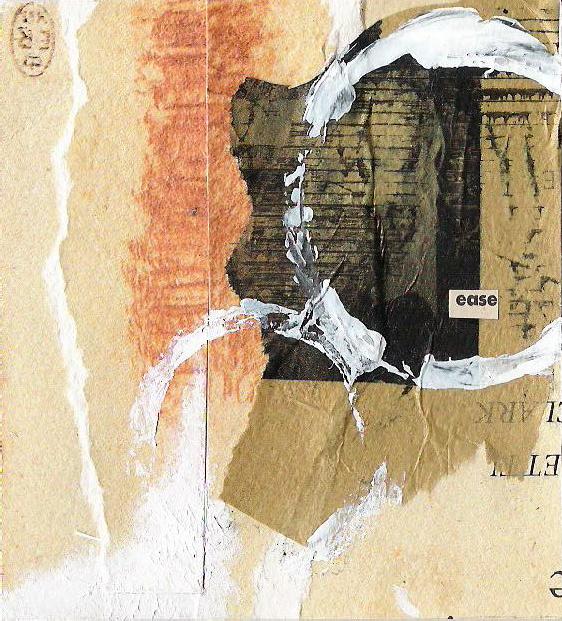
Ease


This one kind of creeps me out, but it's kind of neat, too...

Gathering and Shirring


Intuitive description of the coming of the Kingdom of God...

Monday, November 13, 2006

Answer


Mark 11:20-25
In the morning, as they went along, they saw the fig tree withered from the roots. Peter remembered and said to Jesus, "Rabbi, look! The fig tree you cursed has withered! "Have faith in God," Jesus answered. "I tell you the truth, if anyone says to this mountain, 'Go, throw yourself into the sea,' and does not doubt in his heart but believes that what he says will happen, it will be done for him. Therefore I tell you, whatever you ask for in prayer, believe that you have received it, and it will be yours. And when you stand praying, if you hold anything against anyone, forgive him, so that your Father in heaven may forgive you your sins."—(NIV) New International Version

Fig Tree


Mark 11:12-21
As they left Bethany the next day, he was hungry. Off in the distance he saw a fig tree in full leaf. He came up to it expecting to find something for breakfast, but found nothing but fig leaves. (It wasn't yet the season for figs.) He addressed the tree: "No one is going to eat fruit from you again—ever!" And his disciples overheard him.
They arrived at Jerusalem. Immediately on entering the Temple Jesus started throwing out everyone who had set up shop there, buying and selling. He kicked over the tables of the bankers and the stalls of the pigeon merchants. He didn't let anyone even carry a basket through the Temple. And then he taught them, quoting this text:
My house was designated a house of prayer for the nations;
You've turned it into a hangout for thieves.
The high priests and religion scholars heard what was going on and plotted how they might get rid of him. They panicked, for the entire crowd was carried away by his teaching.
At evening, Jesus and his disciples left the city.
In the morning, walking along the road, they saw the fig tree, shriveled to a dry stick. Peter, remembering what had happened the previous day, said to him, "Rabbi, look—the fig tree you cursed is shriveled up!" --(The Message)